
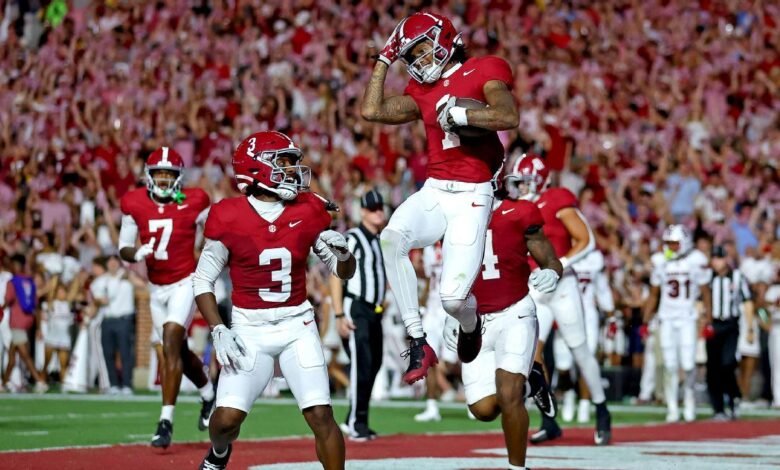
Ala. — Ryan Coleman-Williams thought his issues with dropping the football were a “mental block,” he told ESPN during a recent interview. Alabama’s star wide receiver has never had much trouble getting open — his speed and short-area quickness are elite — and his eyes were usually in the right place to catch the ball. But the drops kept happening, again and again, and his confidence waned
Last season, the former Freshman All-American, who once seemed destined to compete with Ohio State’s Jeremiah Smith for Heisman Trophies, led all Power 4 receivers with 10 drops. And while they were all perplexing in their own way, it was one particular drop in the SEC Championship Game against Georgia last December that prompted Coleman-Williams to search out head athletic trainer Jeff Allen.
“I sat down with Jeff and watched the Georgia game,” Coleman-Williams recalled. “I was going over a go-ball and I just completely missed it.”
Coleman-Williams had a step on the defensive back
Coleman-Williams had a step on the defensive back. Quarterback Ty Simpson lofted the ball in beautifully at Coleman-Williams, who jumped, put both hands out to catch the pass and whiffed. The ball didn’t appear to touch his fingers before hitting him in the numbers and falling to the turf.
“It was because I didn’t see it,” Coleman-Williams said.
He and Allen looked at his vision “a bunch of different ways.” Of course, there was the standard eye test. Cover one eye and read the letters on a chart. Switch eyes and do the same. Coleman-Williams had perfect 20/20 vision, but they already knew that.
“No,” he told Allen. “I can see it. It’s just when it gets right here at the catch point, I don’t know if I’m not looking at it or I can’t see the ball.”
It sounds confusing because it was.
Coleman-Williams was talking to the right person
But Coleman-Williams was talking to the right person. Allen, who has been in his position since Nick Saban arrived in 2007, is known for outside-the-box thinking. He was one of the early adopters of GPS tracking technology embedded in football pads and he helped to create the medical sideline tent that’s become ubiquitous in college football. He once worked with the school’s engineering department to build a custom arm brace reinforced by Kevlar — the stuff in bulletproof vests — in order to provide strength and flexibility.
And Allen was interested in eye sight. Specifically, he said, the concept of “vision performance.”
“You just sit there and say, ‘Well, yeah, that guy he’s dropping the ball,'” Allen explained. “And it starts to turn into almost like a mental thing and people think, ‘Well, it’s a mental issue.’ It’s not a mental issue. This is a physiological, physical issue that we feel like we might be able to correct.”
What they found, stumbling into a new way
What they found, stumbling into a new way to assess vision this summer using virtual reality, was incredible, Allen said. The issue they discovered wasn’t unique to Coleman-Williams and it wasn’t debilitating by any means. But college football at the elite level is a game of thin margins. A small change can often make a big difference.
Coleman-Williams hasn’t dropped a pass in four straight games — twice as long as his longest stretch since the first month of his freshman season. He’s caught at least one touchdown in three straight games — also the longest streak since the first month of his freshman season.
That’s not an accident, Coleman-Williams said ahead of Saturday’s game with Georgia (7:30 p.m. ET, ABC).
Now, Coleman-Williams said, when it comes
“Now,” Coleman-Williams said, “when it comes to the ball, I’m literally like Spider-Man. It’s a lot easier. It’s night and day.”
ALLEN HAS A quote mounted above his office inside the Mal Moore Athletic Facility. In white letters on a crimson background, it reads:
While you are busy waiting for evidence and a well-controlled study in order to make a decision, someone else is doing it and winning.
“If it’s legal and ethical,” Allen said, “then we should be exploring it.”
It’s that ethos that got them started down
It’s that ethos that got them started down this track. About a year and a half ago, Allen heard about a company that had developed virtual reality technology for elderly patients who suffered traumatic brain injuries to work on their reaction time and coordinated movement. It felt applicable to football players returning from lower-body injuries — and so far it has been.
“Between you and me,” Allen said, “I’d like to keep the name of the company off this.”
For now, the secret is theirs, an advantage they’ll guard for as long as possible.
This summer, though, the company that supplies
This summer, though, the company that supplies the technology reached out to Allen with a question: Hey, by the way, did you know that the system has a way to assess vision?
No, he didn’t.
And, yes, he was very much interested.
While everyone understands the importance of muscular and cardiovascular training in athletics, the idea of training our other organs — our eyes and brain — is mostly a foreign concept Allen has spent considerable time attempting to understand. It’s why he’s begun a cognitive performance science department that works under sports medicine.
Allen knew he wanted to test the vision assessment technology. One of the first people he went to was Coleman-Williams.
Look, Allen told Coleman-Williams, we don’t know
“Look,” Allen told Coleman-Williams, “we don’t know a lot about it. We think there may be something to it. We’re going to test a bunch of guys. We want to test you and then we’ll kind of go from there.”
“Yeah,” Coleman-Williams said, “let’s try it.”
What the system tests is what’s called binocular motor control. Picture your left and right eye and how when an object comes closer to you, your eyes narrow and converge to track the object. That convergence influences depth perception.
The system is able to graph each eye’s movements to see how well they’re working in tandem. It looks kind of like an EKG or heart monitor with two lines — left eye, right eye. When convergence is ideal, the lines are almost inseparable.
And sure enough, we did some tests down
“And sure enough, we did some tests down there and the test showed that once the stimulus was right here,” Coleman-Williams said, making a point with his finger a little more than an arm’s length away from his face, “only one eye was tracking it.”
Coleman-Williams wasn’t alone with that issue on the team. And, keep in mind, it’s not an all-or-nothing kind of thing. Like the 20/20 scale for a traditional eye test, there are degrees.
Identifying convergence insufficiency was a good first step.
“Well,” Allen told the VR company, “now what?”
There were some rudimentary tools people can use to potentially improve their convergence. The primary device is called the Brock String, which is a simple white rope with three colored rings on it and has been around for more than a half century. The impact, however, is negligible.
Coleman-Williams dropped a pass in the season-opener against East Carolina last month.
While Coleman-Williams was using the string to try
But while Coleman-Williams was using the string to try to improve his vision, Allen told the company that he’d like them to create a training program for the VR headsets.
However many hundred keystrokes later and viola.
The program arrived before a Week 2 trip to Kentucky. To hear Allen describe it, it’s nothing fancy. (Then again, he may be hiding more trade secrets.) Essentially the user puts on the VR goggles and is shown an object coming at them at varying speeds. By focusing on the act of tracking the object, over and over, the hope is that it trains the eyes to work better in tandem — to converge as close to perfectly as possible.
Allen describes it as “dialing in” your eyesight. Most players use it for about 5 minutes per session, three sessions per week.
I’ve done it myself, he said
“I’ve done it myself,” he said. “When you do the training, you come out and you’re like, ‘Wow.’ I mean, there is definitely something to it. Imagine before you go sprint — you’re going to warm up. Well, we feel like there’s a warmup part here, too, from between the brain and the central nervous system in terms of coordinating vision.”
They can’t score convergence yet but that’s probably coming.
“As you’re doing the test, I can watch the screen and I can see what your eyes are doing,” Allen said. “Someone who is not converging, you’ll see one eye move and the other eye kind of twitch or just stay there. And what we’ve seen with the guys who’ve done the training is that video, it looks incredibly different. They’re both moving in a coordinated fashion, seamlessly right together. It’s really remarkable.”
In a matter of weeks, Coleman-Williams said he’s cut the point where he might lose sight of an oncoming object in half. Now that point is consistently within his catch radius — a spot where he should already have his hands on the football.
At one point, Coleman-Williams decided training three days wasn’t enough.
“I want to do this on game day,” he told Allen.
So they made the VR headsets available in the locker room.
It almost gives me — going back
“It almost gives me — going back to just that work in the offseason and knowing that I put in some time into that — it almost gives me even more confidence,” Coleman-Williams said. “I know it’s my eyes, but my hands have more confidence because it’s like, ‘No, I know I’m looking it in.'”
BRYANT-DENNY STADIUM groaned in disappointment after Coleman-Williams’ drop against East Carolina. In the postgame news conference, Alabama coach Kalen DeBoer was asked about his star receiver — not his 100-yard game but his one drop.
“We’re going to keep feeding him,” DeBoer said. “He’s a relentless worker and he’s going to keep getting the ball.”
DeBoer’s been steadfast in his defense of Coleman-Williams
DeBoer’s been steadfast in his defense of Coleman-Williams. This summer, during a speaking engagement, DeBoer was asked about Coleman-Williams and the undertone of doubt was hard to miss.
DeBoer pointed into the crowd and answered.
I’ll stand on this table and I’ll stand on this table and I’ll stand on this table to defend Ryan.
“He gives himself to everyone,” DeBoer told ESPN during an interview last month. “This community. The fanbase. He is spread so thin and I think people think there’s a lack of focus on the right stuff. There’s not. He goes above and beyond with his time. He was never doing anything wrong. He’s just learning how to handle it even better.”
The work in the offseason that Coleman-Williams referred
The work in the offseason that Coleman-Williams referred to was real. During exit interviews following last season, he laid out a plan to DeBoer and strength coach David Ballou on how he planned to make the most of his junior season. He wanted to get bigger and stronger. He wanted to step into the leadership void left by the departure of veterans like wide receiver Germie Bernard and quarterback Ty Simpson.
One of the most visible athletes in college football, Coleman-Williams went underground this offseason. No photoshoots for video games or magazines. No cross-country trips. He barely left Tuscaloosa. When other players went home, he went to the football facility to lift weights and catch passes.
“This is going on my third season and I’ve seen what worked for us, what hasn’t worked for us, when we were in those lull moments, what we should have done and what didn’t we do,” Coleman-Williams said. “So just being a part of the past two teams, it was like we’ve had all the talent in the world. It’s just about those guys stepping up and being a voice in those times of need. And throughout the all season I was like, ‘Well, I’m going to be that voice.'”
When spring practice rolled around, coaches saw Coleman-Williams
When spring practice rolled around, coaches saw Coleman-Williams as a man on fire. There were very few reports of drops during fall camp.
The Week 1 drop was a setback, but he was stronger mentally than before. Quarterback Keelon Russell said he has a “mindset of steel.”
Coleman-Williams used the VR technology and felt it working. His confidence grew.
“He’s wired the right way,” an NFL scout told ESPN this week. “Are his hands natural? No. But he’s as confident in them as he’s been. The care factor is there. There was a lot thrown at him at 17, 18 years old as an overnight superstar. He was able to grow through some of those things a year ago as part of the maturation process. As a kid, he’s nails.”
Hearing Coleman-Williams tell it, the stress is gone.
Anyone watching him closely can see
Anyone watching him closely can see it. After what he said was one of the hardest years of his football life last season, he’s looking more like the player we saw take the world by storm as a true freshman in 2024 — the big plays but the infectious enthusiasm, too.
Now, he’s dancing with Russell after touchdowns that were thrown to someone else and singing along to “Dixieland Delight” in the fourth quarter.
How much of Coleman-Willliams’ sure hands of late have been physical vs. mental is up for debate. Allen readily admits that not every drop can be explained away by convergence. This area of study is in its infancy. But that’s never discouraged Allen before.
So much of what we do is based
“So much of what we do is based on the reaction we get from our athletes. That’s my research,” he said.
And with Coleman-Williams, Allen said the answer was clear: “I know it helps me.”
“That’s another reason why I’m able to play free, because obviously I know the plays, I know how we want to execute them, and I know my job,” Coleman-Williams said. “So once those three boxes are checked, now it’s just catch the ball. And after that, all my God given ability is going to take over.”
Yes, Coleman-Williams said, his joy is back.
“I mean, it’s almost like the offseason was the milkshake and we threw the whipped cream on at the fall camp,” he said, grinning, “and then the vision stuff was just cherry on top.”
Source: www.espn.com